
The Delta · Weekly · 2 – 8 November 2026
In the banks' books, investor loans all but stopped growing in September; August's fall was at a bank that sold loans
In the banks' books, investor home loans outstanding grew by $33 million in September, less than 0.01%, against 0.74% in September 2025, the least in any September since 2020 (the series starts in 2019; 2019 and 2020 were both falls); owner-occupier loans grew 0.38%, against 0.49%, the least in any September since 2019, the first September in the series. In July, investor loans grew 0.13%, against 0.50% a year earlier, and owner-occupier loans 0.27%, against 0.28%. August's fall of $14,119 million was at one lender, in the month the lender reported selling a mortgage portfolio of about $15.4 billion on 1 August to a group led by a lender outside the banking system; with it added back, the banks' home loans grew at about the pace of July and September, not a collapse. Counting lenders outside the banking system as well, investor housing credit was reported growing about 0.2% in September, on a measure that may be adjusted and is not like for like with the banks' figures: slower, but not stopped.
What the headlines said
On 3 November the Reserve Bank lifted the cash rate to 4.85%, from 4.60%, as reported that afternoon.
Before the decision, a rise was reported in late October as the more probable outcome, after inflation was reported faster in the year to September than in the year to August; after the September figures of 28 October all four major banks were reported to expect a rise. Investors were reported in October to have stepped back since the May budget's proposed changes to negative gearing and the capital gains discount, and investor credit growth to have slowed sharply. The August fall in one bank's home-loan book, below, was reported as a collapse in mortgage growth.
On 4 November, the day after the decision, investors' new loan commitments were reported to have fallen further than in any rate-rising cycle on record, and owner-occupiers' to have fallen less; at the decision's press conference, as reported, a fall so much larger than in past rate rises was said to point to the tax changes. The major banks were reported to be passing the rise on to variable home-loan rates from 13 November.
The common reading: investors have stepped back since the budget, and one bank's August fall was a collapse in mortgage growth.
What our data says
Every month, the Australian Prudential Regulation Authority (APRA) publishes the home loans that banks and other deposit-takers hold at the month's end, investor and owner-occupier. Lenders outside the banking system, such as non-bank lenders, are not included. Its latest month is September 2026. These are loans outstanding, a stock: a month's change is new loans less repayments, not new lending.
In August one lender's home-loan book fell by $14,119 million. APRA does not say why. The lender reported selling a mortgage portfolio of about $15.4 billion on 1 August to a group led by a lender outside the banking system: loans that left the banks' books, not the market. So August is left out: July is read on June, and September on August, each against the same month a year earlier.
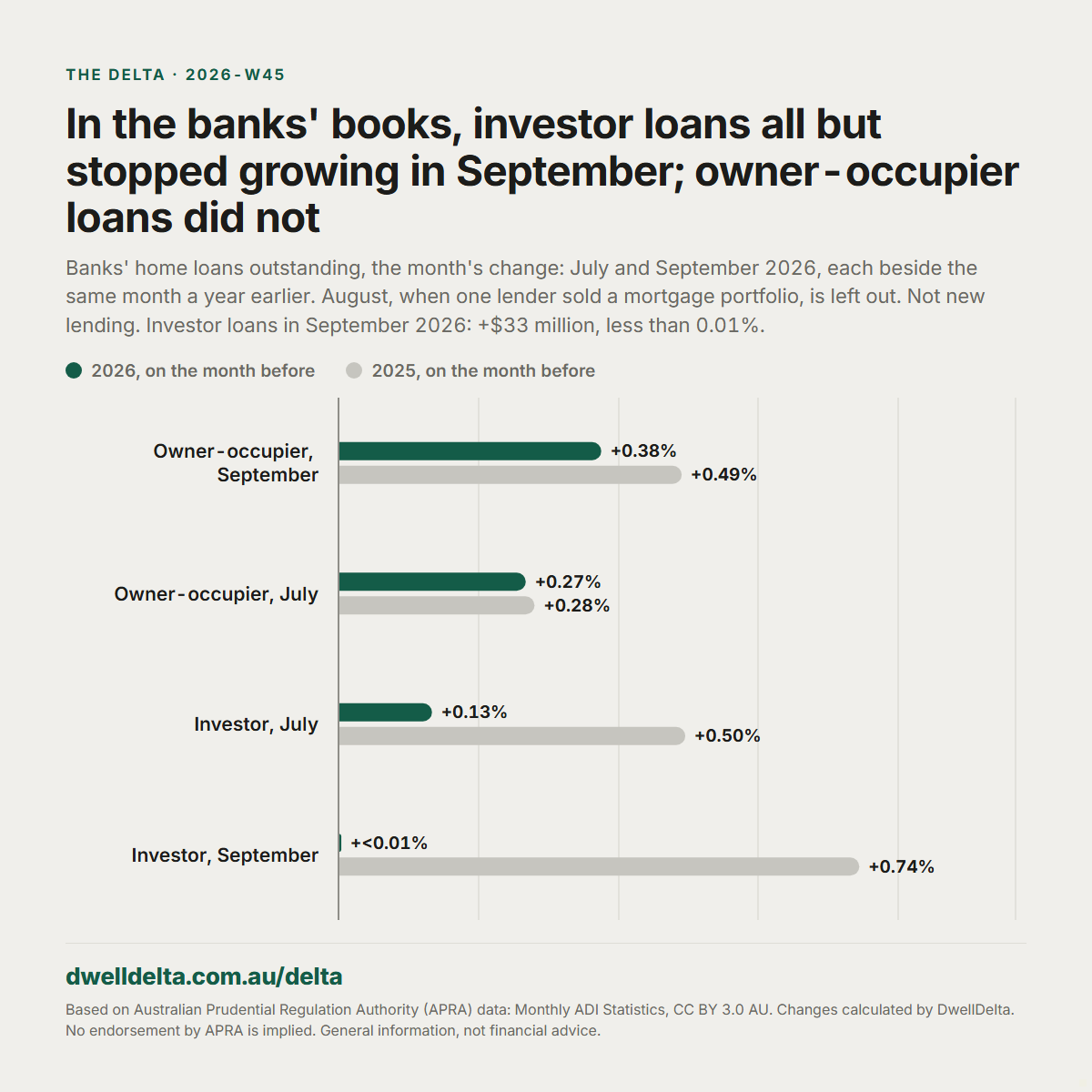
| Banks' home loans outstanding, Australia | Investor | Owner-occupier |
|---|---|---|
| September 2026 on August 2026 | +$33 million (less than 0.01%) | +$6,334 million (+0.38%) |
| September 2025 on August 2025 | +$5,669 million (+0.74%) | +$7,868 million (+0.49%) |
| July 2026 on June 2026 | +$1,097 million (+0.13%) | +$4,515 million (+0.27%) |
| July 2025 on June 2025 | +$3,730 million (+0.50%) | +$4,464 million (+0.28%) |
| Year to July 2026 | +8.68% | +5.85% |
| Year to July 2025 | +6.13% | +5.64% |
| Held at the end of September 2026 | $818.2 billion | $1,691.8 billion |
The average variable rate on new home loans the banks funded was 6.16% in the June quarter, up from 5.53% in the December quarter 2025, 0.63 points higher, and against 5.82% a year earlier, before the rise of 29 September. The figure we hold does not split investor from owner-occupier loans.
Where we differ
August's fall was at one bank, in the month it reported a portfolio sale; not a collapse. The fall reported as a collapse in mortgage growth was in one lender's book, in the month it reported selling a mortgage portfolio to a group led by a lender outside the banking system. With the $14,119 million added back, the banks' home loans grew $6,349 million (+0.25%) in August, against $11,628 million (+0.49%) in August 2025, and about the pace of July (+0.22%) and September (+0.25%): slower than a year earlier, with no sudden fall. How the fall splits between investor and owner-occupier loans is not in the figures we load, so August is not read by book.
Investors slowed, as reported; in the banks' books they all but stopped. Investor loans all but stopped growing in September: they rose by $33 million in the month, against $5,669 million in September 2025. Counting lenders outside the banking system as well, investor housing credit was reported growing about 0.2% in September: slower, but not stopped. That figure may be seasonally adjusted and adjusted for breaks, and ours are not, so the two are not compared here. In September investor loans grew less than in any September since 2020 (the series starts in 2019; 2019 and 2020 were both falls). Owner-occupier loans grew 0.38%, more slowly than the 0.49% of a year earlier, but still by $6,334 million; their 0.38% was the least in any September since 2019, the first September in the series. September's figures end on 30 September, the day after the rise of 29 September, too soon for it to show in loans outstanding.
In the banks' books, the turn is about two months old. The turn in investors showed in July, after the rate rises of February, March and May and the budget of 12 May, and before the rise of 29 September. In July investor loans grew 0.13%, against 0.50% a year earlier; owner-occupier loans grew 0.27%, against 0.28%, about the same. Owner-occupier loans grew more slowly than a year earlier in every month from January to July, January and February by less than 0.01 points; only March, May and June by more than 0.05. Over the year to July, investor loans grew 8.68%, against 6.13% in the year to July 2025, and owner-occupier loans 5.85%, against 5.64%, close to the year before's pace. In 10 of the 12 months to July, investor loans grew faster than in the same month a year earlier; in the other two, December and July, they grew more slowly, December by less than 0.01 points. Every change over a year from August includes the August fall, so this issue reads the year to July.
What the books cannot say is why. The budget's proposed changes for investors, as reported, the rate rises, lenders' policies and loans leaving the banks' books could each play a part; loans outstanding cannot tell them apart. They are a stock, not new lending: a book stops growing when repayments match new loans, so a flat investor book can still hold new investor loans. APRA's figures for new loans funded in the September quarter are due in December. The rise of 3 November cannot show in these books before November's figures. At the decision's press conference, as reported on 4 November, investors' new loan commitments falling so much further than in past rate rises was said to point to the tax changes; loans outstanding can neither confirm nor rule that out.
How we measured
- APRA Monthly Authorised Deposit-taking Institution Statistics, September 2026: the back-series, Table 1, loans to households for housing, owner-occupied and investment, in $ million at each month's end, summed over every reporting bank, building society and credit union (118 in both August and September 2026). 119 reported in July, two more than in June: both are in July's totals, and neither held home loans. Not seasonally adjusted.
- Every change is calculated by DwellDelta from those totals and printed to two decimals. Matched months only: a month on the month before against the same month a year earlier on its month before, and a year against the year before it.
- August 2026: one lender's home-loan book fell by $14,119 million in the month. APRA's release and workbook say nothing of why. The lender's own release of 10 August 2026 says its sale of a mortgage portfolio on 1 August reduced its home loans by $15.4 billion. The lender's figure is its own, not on APRA's basis (APRA's figures are each bank's own domestic book, without its special purpose vehicles or subsidiaries), and is larger than the fall in APRA's figures; how much of the $14,119 million the sale accounts for is not known. Every change over a year from August 2026 to July 2027 includes the fall. Over the year to September, all the banks' home loans together grew 5.57% as published, and 6.16% with the $14,119 million added back. How it splits between investor and owner-occupier loans is not in the figures we load, so neither is adjusted, and the year to September is not read.
- Before September on August was read, these checks were run: no lender's home-loan book moved by $5 billion and 2% of itself in September; each major bank's September change, investor and owner-occupier, was read: none moved by more than in its largest month of the year to July, but three fell: one major's owner-occupier and investor books, and another's investor book. Together the four majors' investor books grew by $4 million; why the three fell is not known. The September file gives August's totals as first published, and the same number of lenders reported in both months.
- A lender moving loans between investor and owner-occupier within its own book would not be flagged. In March 2021 investor loans fell $18,823 million and owner-occupier loans rose $28,708 million in one month, mostly at one lender, and nothing was flagged. None of the four major banks' investor books fell in September while its owner-occupier book rose by a like amount, as March 2021's did; a smaller move of that kind could still sit in September's figures.
- The September check of each major bank, the two lenders added in July and March 2021's one lender were read by hand from the stored APRA workbook (sha256 0aed5810a9c3827d709d0c1ebeb6a7f2dd6b384723a65339633067630ebcee2b), not by the script.
- The average variable rate on new loans: APRA Quarterly Authorised Deposit-taking Institution Property Exposures, the weighted average variable rate of new loans funded, all deposit-takers, December quarter 2025 to June quarter 2026.
- Lenders outside the banking system, such as non-bank lenders and private credit funds, are not in these figures, nor loans a bank has sold or securitised off its books.
- The headline claims are reported by their direction only, apart from the cash rate of 3 November and investor housing credit across all lenders in September, as reported, cited by date, not named, because DwellDelta names only sources it can use commercially.
- This is one edition and is not updated. Its inputs are frozen with the checksum of every file read, and every figure comes from a script that reads them, apart from the checks read by hand, above.
Is your rent fair? Check it in a minute, and add yours to help others.
General information, not financial advice.
Sources
- Based on Australian Prudential Regulation Authority (APRA) data: Monthly Authorised Deposit-taking Institution Statistics and Quarterly Authorised Deposit-taking Institution Property Exposures, © Australian Prudential Regulation Authority, licensed under CC BY 3.0 AU (creativecommons.org/licenses/by/3.0/au). The changes are calculated by DwellDelta from APRA's figures. No endorsement by APRA is implied.
- Rate decision: Reserve Bank of Australia, February, March and May, 29 September and 3 November 2026, as reported: its pages refuse automated readers like ours in their robots rules, so we did not read them. No endorsement by the Reserve Bank is implied.
- The portfolio sale: the lender's own release to the stock exchange of 10 August 2026, read by DwellDelta; the buyer as reported in August 2026.
- Headlines, the budget of 12 May and investor housing credit across all lenders: as reported in October 2026 and on 2, 3 and 4 November 2026, cited by date and not named, because DwellDelta names only sources it can use commercially. They were found by web search on 2026-10-20, 2026-10-27, 2026-10-28, 2026-11-03 and 2026-11-08 and were not read in full.
Added later
9 November 2026: the issue's main points in plainer words. The issue above stays as published, and no figure has changed.
In the banks' books, investor home loans all but stopped growing in September. These are the banks' figures only, not the whole market. August's fall, reported as a collapse in mortgage growth, was at one lender. It was not a collapse.
The figures are loans still owed, not new lending: the total can stand still while new loans are written, if repayments match them.
The cash rate rose on 3 November, as reported, and investors were reported to have stepped back since the budget. The banks' figures show investor loans slowing from July. They stop at 30 September, so that rise is not in them.
July: investor loans grew 0.13%, against 0.50% in July 2025. This is where the slowing showed.
August: one lender's home-loan book fell by $14,119 million. The banks' figures do not say why. The lender reported selling a mortgage portfolio that month; how much of the fall the sale accounts for is not known. Add that fall back and the banks' home loans, investor and owner-occupier together, grew at about the pace of July and September. That is slower than a year earlier, but not a collapse.
September: investor loans grew less than 0.01%, against 0.74% in September 2025. Owner-occupier loans still grew, more slowly than a year earlier.
What these figures leave out:
Lenders outside the banking system. Counting them as well, investor housing credit was reported still growing in September, on a different measure that cannot be compared directly with these.
New loans. Investors' new loan commitments, a separate measure, were reported to have fallen further than in any rate-rising cycle on record.
Why investors slowed. The budget's proposed changes for investors, as reported, the rate rises, lenders' policies and loans leaving the banks' books could each play a part. These figures cannot tell them apart.